COMPLEXTREES

Bernat Espigulé / Artist & mathematician

I make trees
that have
never grown.

Original geometries, made tangible. A practice moving between mathematical discovery, sculpture and the changing conditions of looking.

Explore selected work
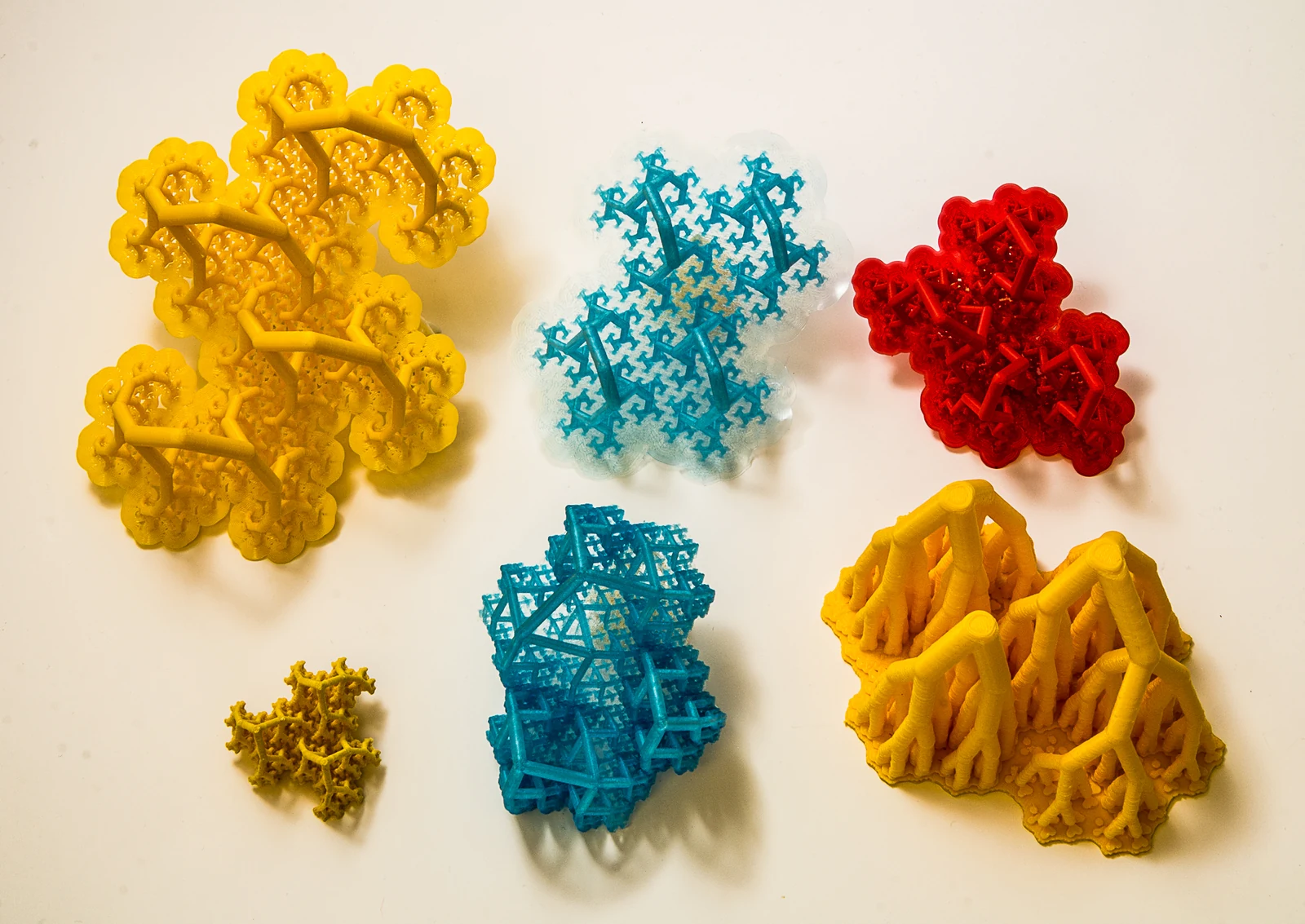
An ensemble of yellow, blue and red branching sculptures arranged on a light surface; each follows a different recursive structure.
Arboretum of 3D-Printed Complex Trees2019
Selected sculpture, animation, cartography & research software2013—2026

A selection

Geometry becomes an object.

Branches, surfaces, openings and shadows. Each work begins with a rule; making it introduces another set of questions.

01 Current sculpture

Complex-Tree
Table

2026 · 3D-printed scale prototype

A recursively generated branching structure becomes a supporting body. The prototype brings a mathematical geometry into physical space, between sculpture, architecture and furniture.

Seen from above, it gathers into a surface. From below, that surface gives way to a population of branches and the spaces between them.

Scale prototype · workshop documentation.

Earlier work: The Fludgeflake Table, 2013
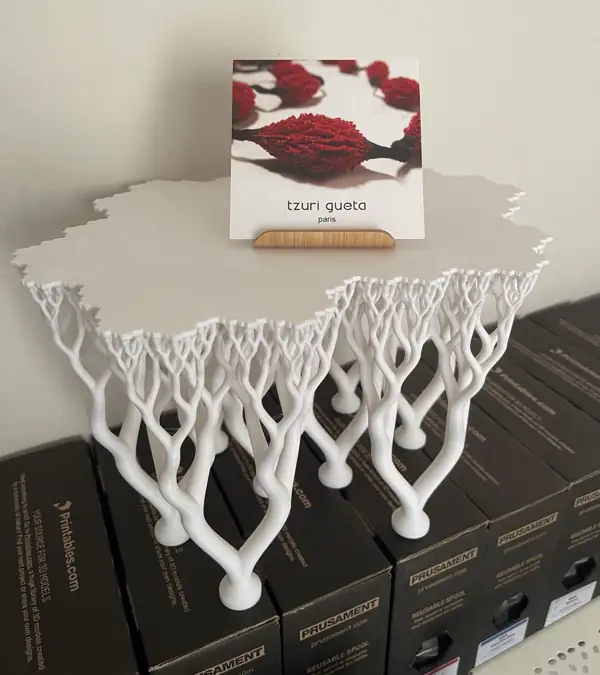
A white table prototype whose irregular surface is supported by densely branching structures, photographed in the workshop with display materials and filament boxes.
Complex-Tree Table · workshop documentation

02 Object & viewpoint

The Sierpinski
SuperFractal

2013 · Nylon and stainless-steel versions

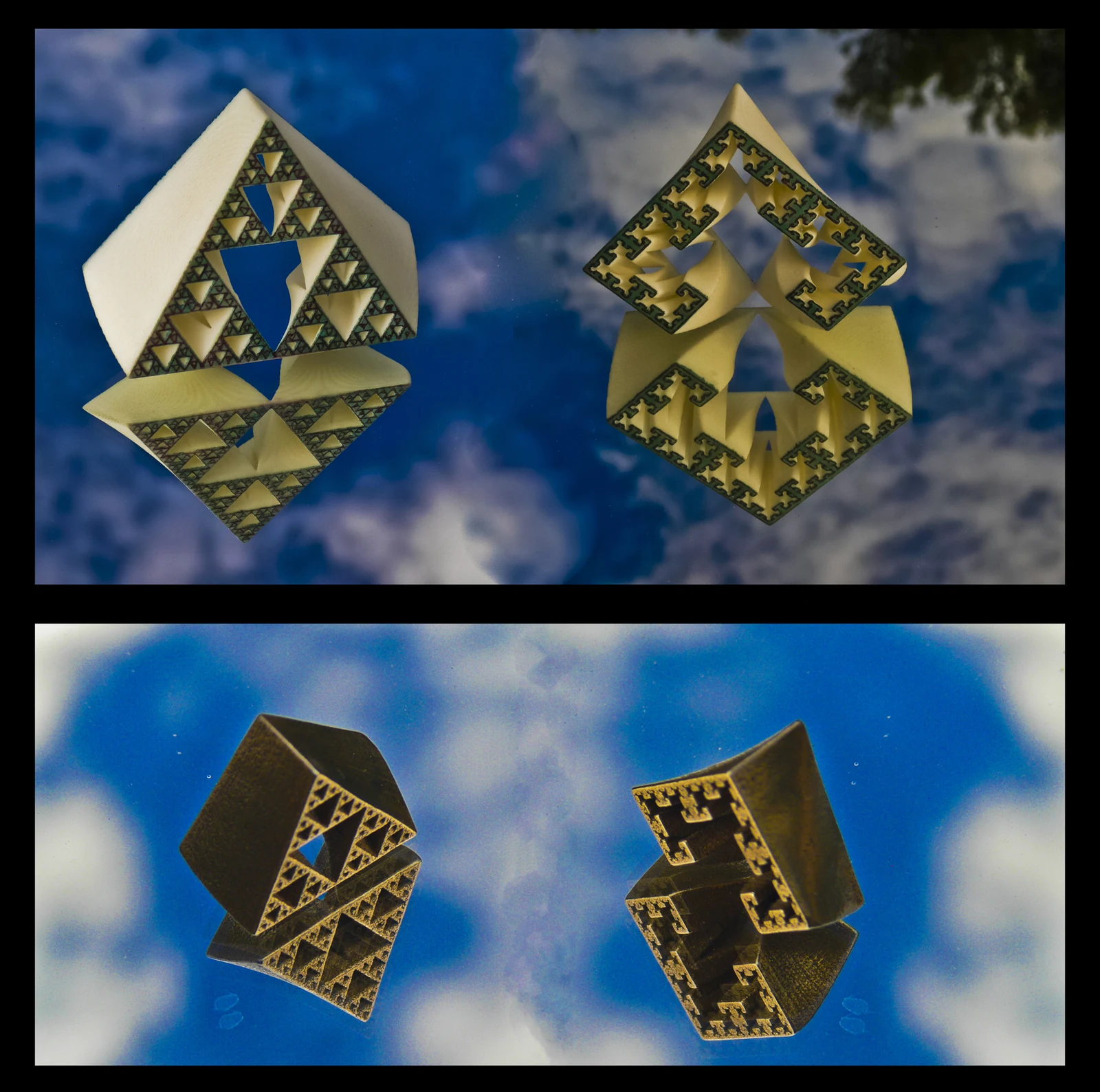
A Sierpiński triangle on one side; a carpet-like structure on the other. A change of viewpoint brings a different geometry forward, while the physical object remains the same.

The paired views and reflections make that transition a matter of perception as much as construction.

Exhibited at the Joint Mathematics Meetings, 2014
Two pairs of views of the SuperFractal, in pale nylon and metal, showing triangular and carpet-like faces reflected in a mirror against the sky.
Two materials, contrasting views · 2014 exhibition image

03 Branching & self-contact

The Ternary Self-Contacting
Golden Trees

2013 · Laser-sintered nylon · designed in Mathematica

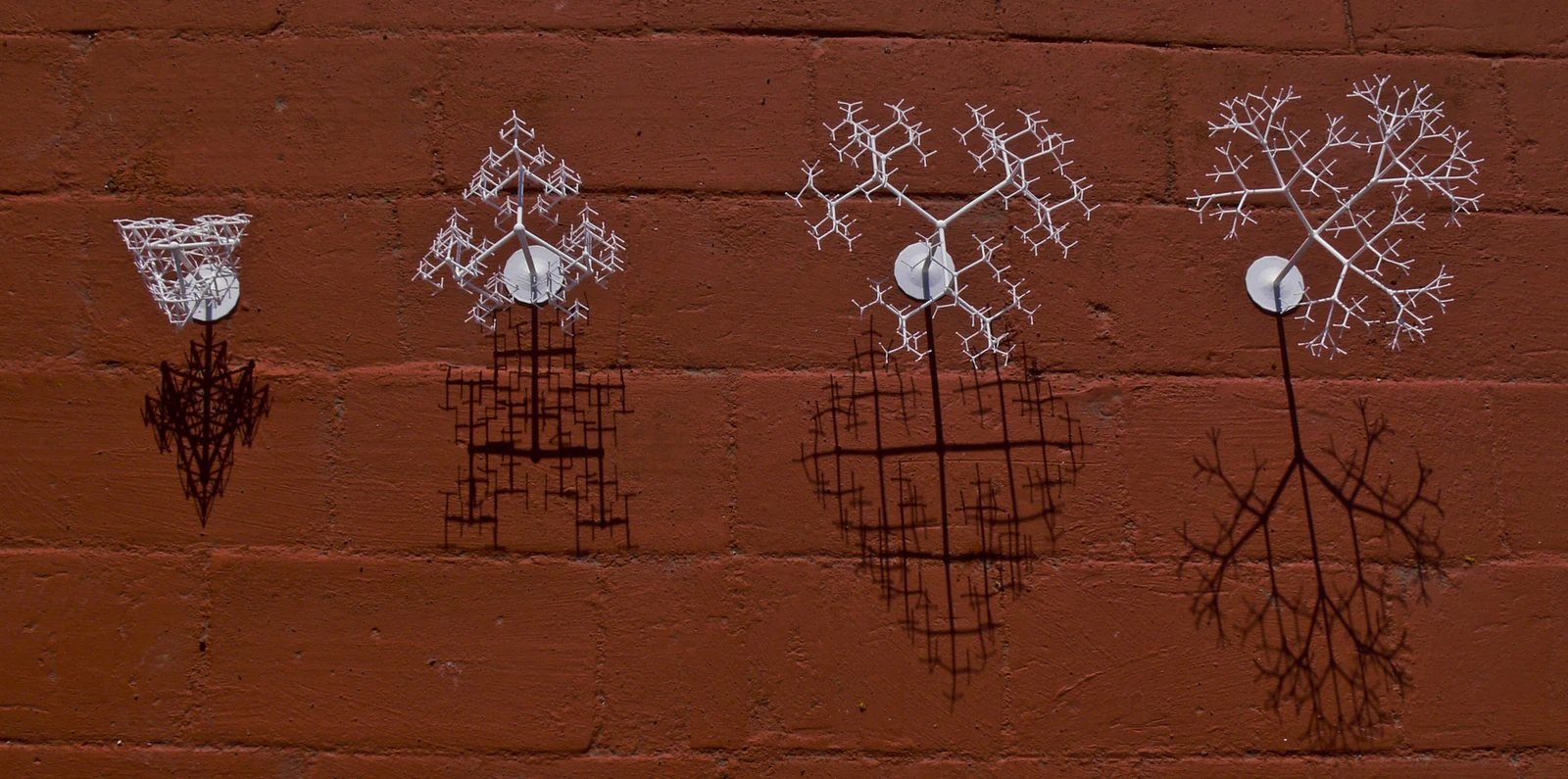
A family of branching forms at self-contact. The sculptures and their shadows reveal different aspects of the same spatial structures; their apparent intricacy emerges from repeated rules.

Exhibition record · JMM 2014
Four white branching sculptures against a brick-red wall, casting complex shadows with markedly different shapes.
A selection from the six-form series · objects and cast shadows

04 Specimens & moving families

An arboretum.
A space of forms.

2019 · ABS sculptures and digital animation

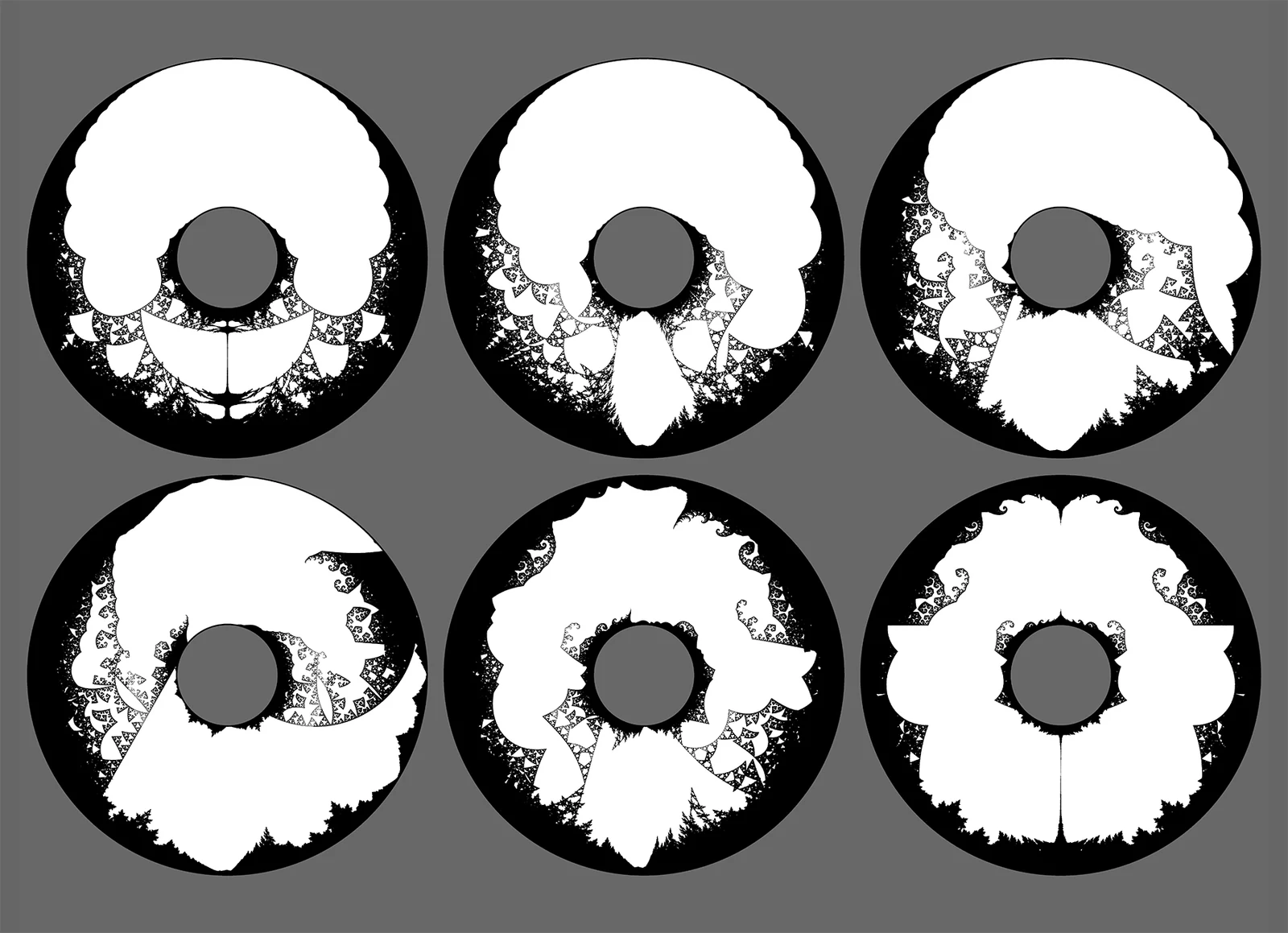
The Arboretum of 3D-Printed Complex Trees, pictured above, gathers individual geometries as physical specimens. The separately exhibited animation opens another view: movement through an entire family of connected self-similar sets.

A chosen object is no longer an isolated shape, but one possibility among its neighbours.

Animation: Tour into a one-parameter space of connected self-similar sets, 2019.

ICERM · Illustrating Mathematics, 2019
Six black-and-white configurations from a parameter-space animation, with related circular boundaries and changing internal branches. Watch the animation
Exhibition still · video opens on YouTube

05 Material & openings

The Starry
Pentagasket

2021 · Laser-cut plywood · 5 × 5 cm

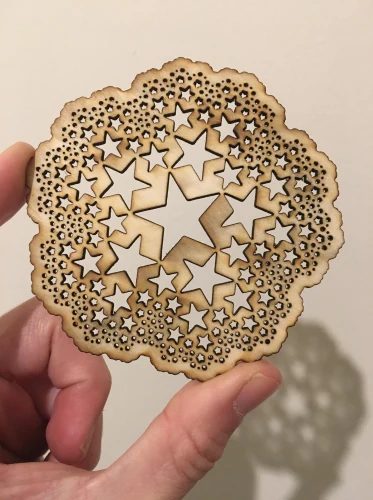
A small object opens into a hierarchy of five-pointed stars. Cutting turns a recursive construction into an interplay of material and absence, with the boundary casting a second, shifting drawing.

Its geometry returns to a branching rule I began exploring in 2011.

Exhibited at Bridges, 2022
A hand holds a small laser-cut plywood ornament filled with progressively smaller star-shaped openings; its shadow falls on the wall.
The Starry Pentagasket · 2021

06 Research software & interactive exploration

Collinear Fractals
Interactive Explorer

2026 · Open-source research software · v0.2.0-alpha

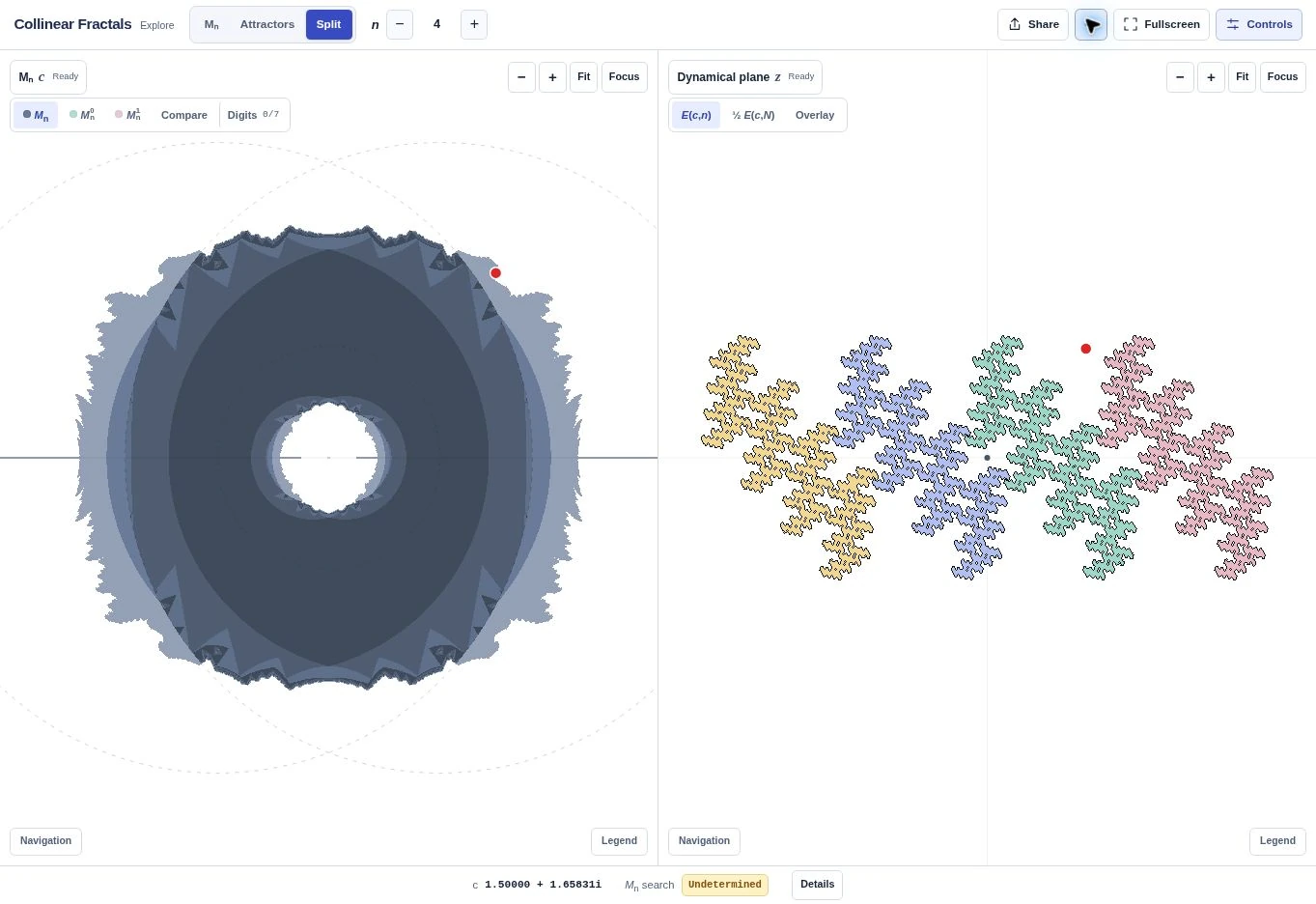
An interactive environment for exploring collinear fractals and the parameters that govern their connectedness. The parameter and dynamical views link a selected value to its associated geometry, turning a family of forms into a space to navigate.

The Collinear Fractals browser explorer: controls at left, a parameter-plane map in the centre and the associated fractal in the dynamical plane at right.
Actual explorer view · n = 4, c = (3 + i√11)/2Open this configuration ↗

Developed alongside my research on finite capture and restricted polynomial roots, the explorer combines geometric overlays, finite inverse-search data, comparison modes, shareable views and image export. It is both a research instrument and a visual working tool: a way to discover structures, compare neighbouring geometries and prepare material for further investigation.

Choose a curated example, explore the parameter plane, then save or share the view.

Research alpha · finite-depth exploration. A static preview is shown here; the explorer runs only when you open it.

The practice

Not one shape.
A field of possibilities.

I explore families of forms, not only finished objects.

Mathematical research provides a way to move deliberately between configurations and understand their relationships. Fabrication introduces scale, thickness, material and the point at which repetition must stop.

These are not interchangeable representations. An image, a proof and a physical object each make different aspects of a form available.

See the research software
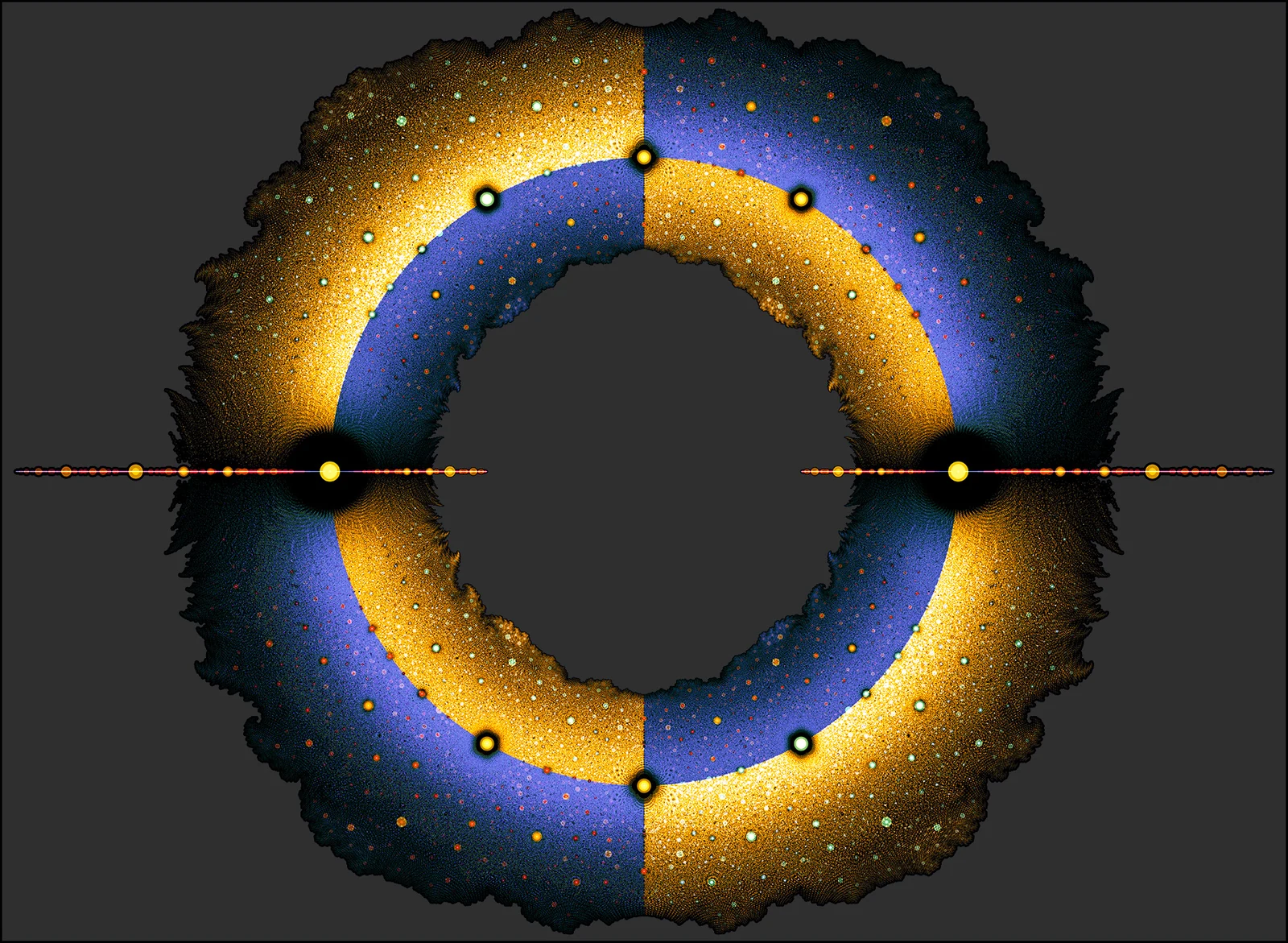
A detailed circular map of polynomial roots, with gold and blue regions and bright algebraic landmarks on a dark background.
The Beauty of Roots · 2019
Photographic print · 40 × 56 cm
Exhibition record ↗

Current enquiry · proposed research, 2026

A Body Without
an Original

What can a form that was not copied from an organism reveal about a biological model?

I propose to bring selected mathematical geometries into exchange with tissue modelling and engineering, allowing the encounter to change how the forms are made and interpreted. This is a research proposal, not a completed artwork or an established biomedical collaboration.

An unexpected biomedical connection

A 2018 study of engineered kidney tubules cited my 2013 paper on self-contacting fractal trees among its geometric precedents. I did not participate in the study. That independent connection motivates a new enquiry into the passage between invented form and biological model.

Benedetti et al., Engineered Kidney Tubules for Modeling Patient-Specific Diseases and Drug Discovery. EBioMedicine 33 (2018), 253–268.

Read the publication record

About the artist

Bernat
Espigulé

Alt Empordà, Catalonia

Bernat Espigulé is a Catalan artist and mathematician. Through Complex Trees, his practice connects sculpture, animation and computational drawing with original research on self-similar geometry and connectedness.

His sculptural work dates to 2013. Trained in physics and mathematics, he has completed his doctoral research at the University of Girona. His professional experience also includes computational communication at Wolfram Research, contributions to the History of Mathematics virtual exhibition for the National Museum of Mathematics, and content development for CosmoCaixa Barcelona.

Working from the territory between the Albera massif and the Mediterranean, he brings mathematical discovery into dialogue with natural observation and the practical decisions of making.

In conversation · CatalanFòrum de Ciència Ràdio l’Escala · interview with Jordi Estévez and Assumpció Vila